Cancer survival
What is cancer survival?
Cancer survival refers to a measurement of how many people diagnosed with cancer are still alive a certain number of years after their initial diagnosis.
More specifically, it is most often reported as the percentage of people alive at one, five or 10 years after diagnosis.
There are many factors that can affect cancer survival. These include:
- cancer type
- cancer stage
- treatment given
- age and general health.
 Important
Survival rates are only calculated at the end of a certain period of time. It is not possible to know what survival rates will be in the future.
In Australia, the survival rates for most cancers are increasing due to improvements in earlier detection, treatment and care.
What is all-cause survival?
An all-cause survival is an estimate of the likelihood of people in a cancer group surviving all causes of death after a certain period of time.
An all-cause survival provides useful information but cannot be used on its own to measure the impact of cancer. This is because deaths in the cancer group may be from cancer, or from something else.
What is relative survival?
Relative survival compares the actual survival rate of people in a cancer group with the expected survival rate in a similar group of people without cancer.
It is used to reduce the effect of non-cancer deaths on the survival rate and give a more accurate measure of survival from cancer.
Given the way it is calculated, relative survival is always higher than all-cause survival for a particular cancer group.
Overall key findings:
- Five‑year relative survival rates vary for different cancer types.
- In NSW, all‑cause survival for all cancers has improved, but there are some differences between local health districts (LHDs).
- Most deaths from cancer occur in older age groups.
Five‑year all‑cause survival*, by cancer type, NSW andlocal health district (LHD) of residence, 2006–2010 and 2011–2015
Key findings:
- For all the cancers listed above, five‑year all‑cause survival rates increased for people in NSW diagnosed between 2011 and 2015, compared with those diagnosed between 2006 and 2010.
- There was variation in survival rates across different cancer types, and among LHDs.
- In 2019, the five new cancer types added to this chart were neurological, sarcoma, non-Hodgkin’s lymphoma, acute leukemia, and multiple myeloma.
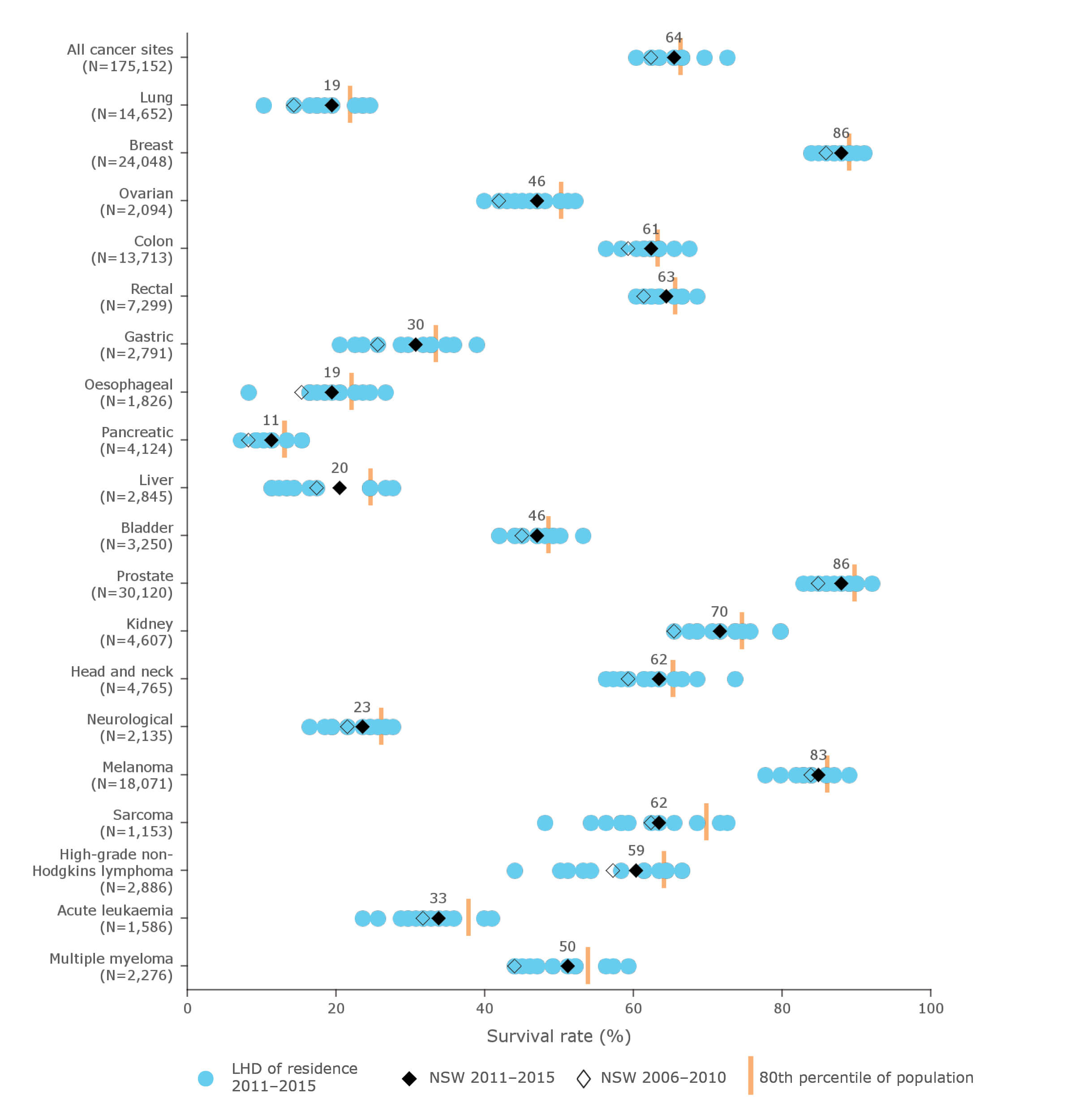
N= Number of first cancer cases in NSW in 2011–2015. Case counts may differ from reported incidence due to the exclusion of cases notified by death certificate only, restriction to ages 15–100 years at diagnosis, and use of a linked dataset.
- All-cause survival was measured by local health district of residence with adjustment for age and gender. Survival rates shown here are lower than survival data published on the cancer Institute NSW website, which reports relative survival from cancer.
Notes:
1. Data source: NSW cancer Registry (NSWCR) with mortality followed up from linked death data from NSW Registry of Births Deaths and Marriages (RBDM), and National Death Index (NDI). Interstate death data were unavailable.
2. Survival rates were suppressed if there were less than 10 deaths
Five‑year relative survival* for all people diagnosed with cancer, by age group and period of diagnosis, NSW, 1972–2015
Key findings:
- Five‑year relative survival rates increased considerably for people in NSW diagnosed with cancer between 2011 and 2015, compared with those diagnosed between 1981 and 1990.
- Between 1972 and 2014, younger people diagnosed with cancer had a higher five‑year survival rate, compared with older age groups.
- For people diagnosed between 2011 and 2015, relative survival rates were the highest for those aged 25–34 years and 15–24 years.
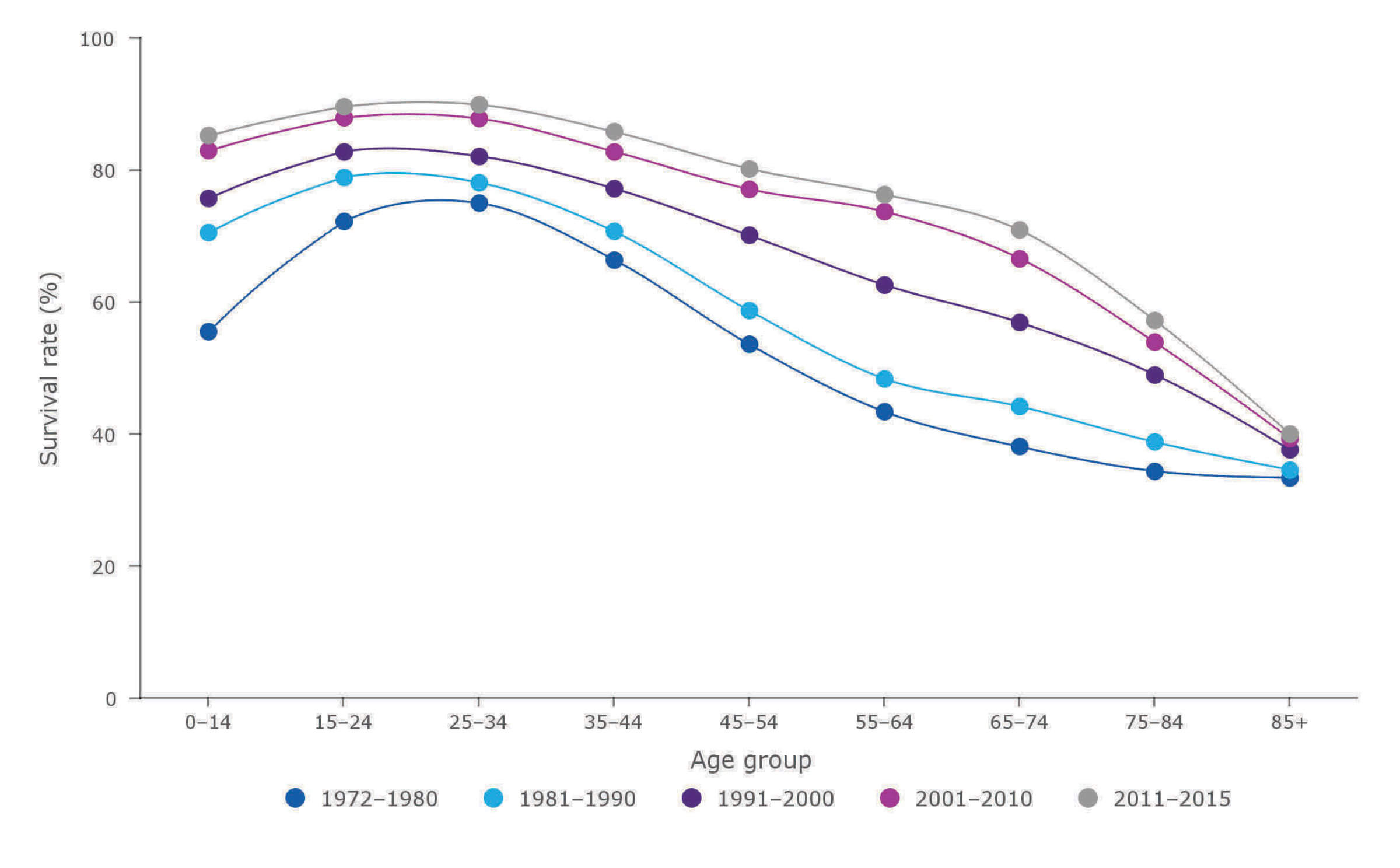
N= Number of cases. Case counts may differ to reported incidence due to the exclusion of cases notified by death certificate only or aged over 100 years at diagnosis, and the use of a linked dataset.
* Relative survival is an estimate of the probability of surviving cancer in the absence of other causes of death.
Notes:
1. Data source: NSW Cancer Registry (NSWCR) with mortality followed up from linked death data from NSW Registry of Births Deaths and Marriages (RBDM) and National Death Index (NDI). Interstate death data were unavailable.
Five‑year relative survival* for all people diagnosed with cancer, by age group and period of diagnosis, NSW, 1981–1990 and 2011–2015
Key findings:
- Five‑year relative survival rates increased considerably for people in NSW diagnosed with cancer between 2011 and 2015, compared with those diagnosed between 1981 and 1990.
- Between 1972 and 2014, younger people diagnosed with cancer had a higher five‑year survival rate, compared with older age groups.
- For people diagnosed between 2011 and 2015, relative survival rates were the highest for those aged 25–34 years and 15–24 years.
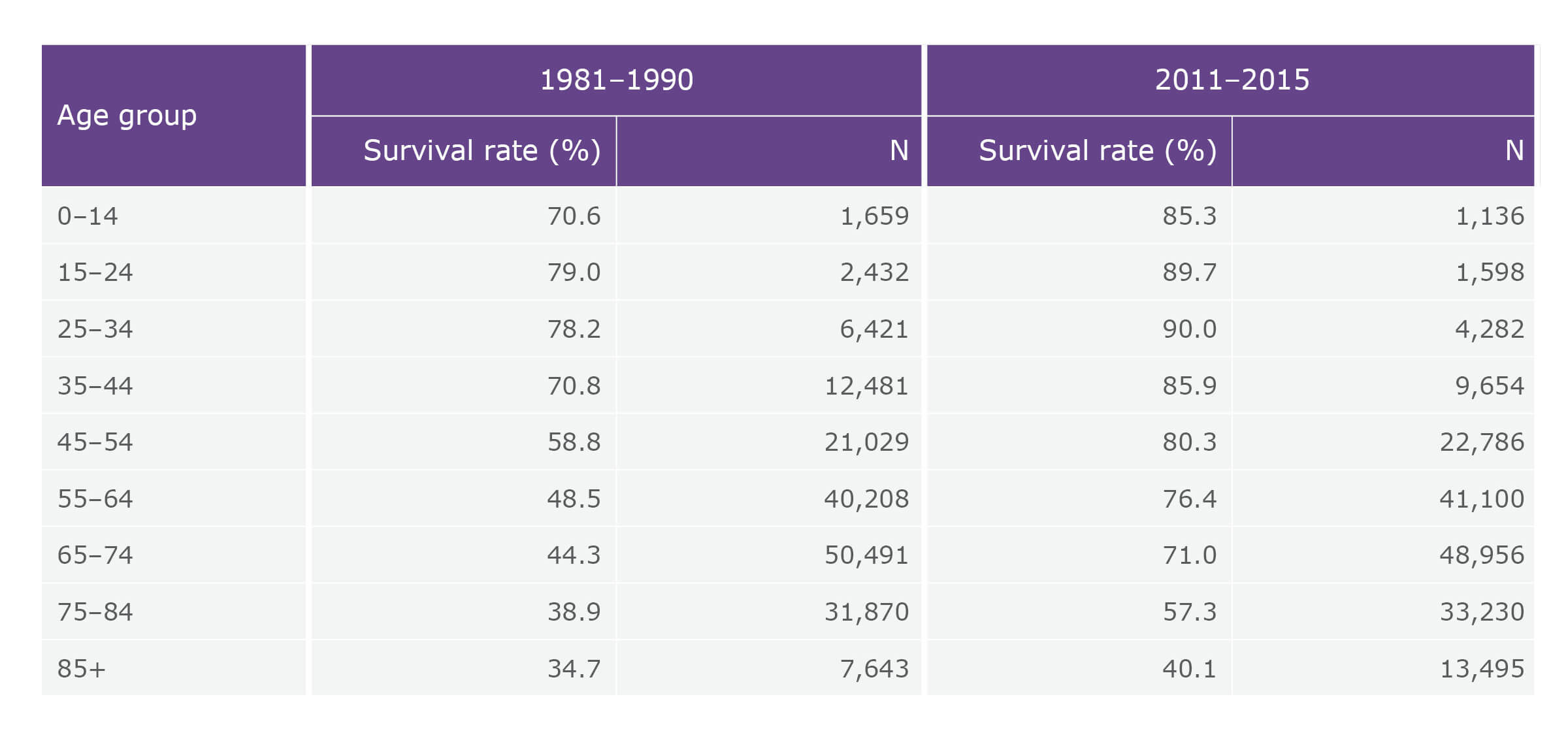
N= Number of cases. Case counts may differ to reported incidence due to the exclusion of cases notified by death certificate only or aged over 100 years at diagnosis, and the use of a linked dataset.
* Relative survival is an estimate of the probability of surviving cancer in the absence of other causes of death.
Notes:
1. Data source: NSW Cancer Registry (NSWCR) with mortality followed up from linked death data from NSW Registry of Births Deaths and Marriages (RBDM) and National Death Index (NDI). Interstate death data were unavailable.
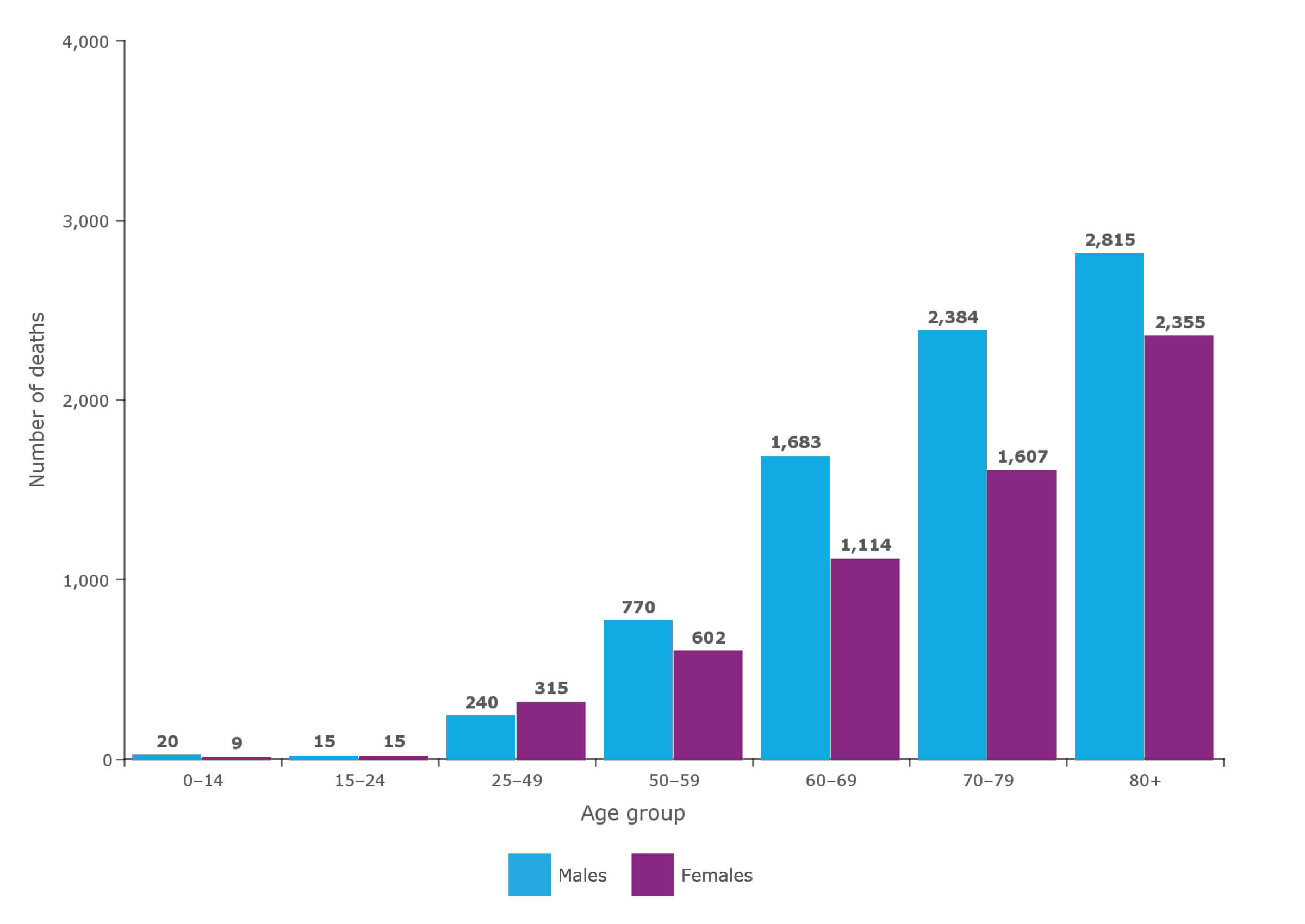
All cancer deaths, by age group, NSW, 2016
Key findings:
- Overall, in 2016, more men than women died from cancer in NSW.
- In 2016, the number of cancer deaths was higher in older age groups. This finding reflects the fact that cancers become more frequent as people age.
Notes:
1. Data source: Annual NSW cancer incidence and mortality dataset, 2016 (sourced from the NSW Cancer Registry (NSWCR)).
Five most common* cancers, by extent of disease at diagnosis, adolescents and young adults aged 15–24 years, NSW, 2011–2015
Key finding:
- Between 2011 and 2015, the five most common cancers in adolescents and young adults (aged 15–24 years) in NSW were testicular, melanoma, thyroid, bowel and neuorlogical.
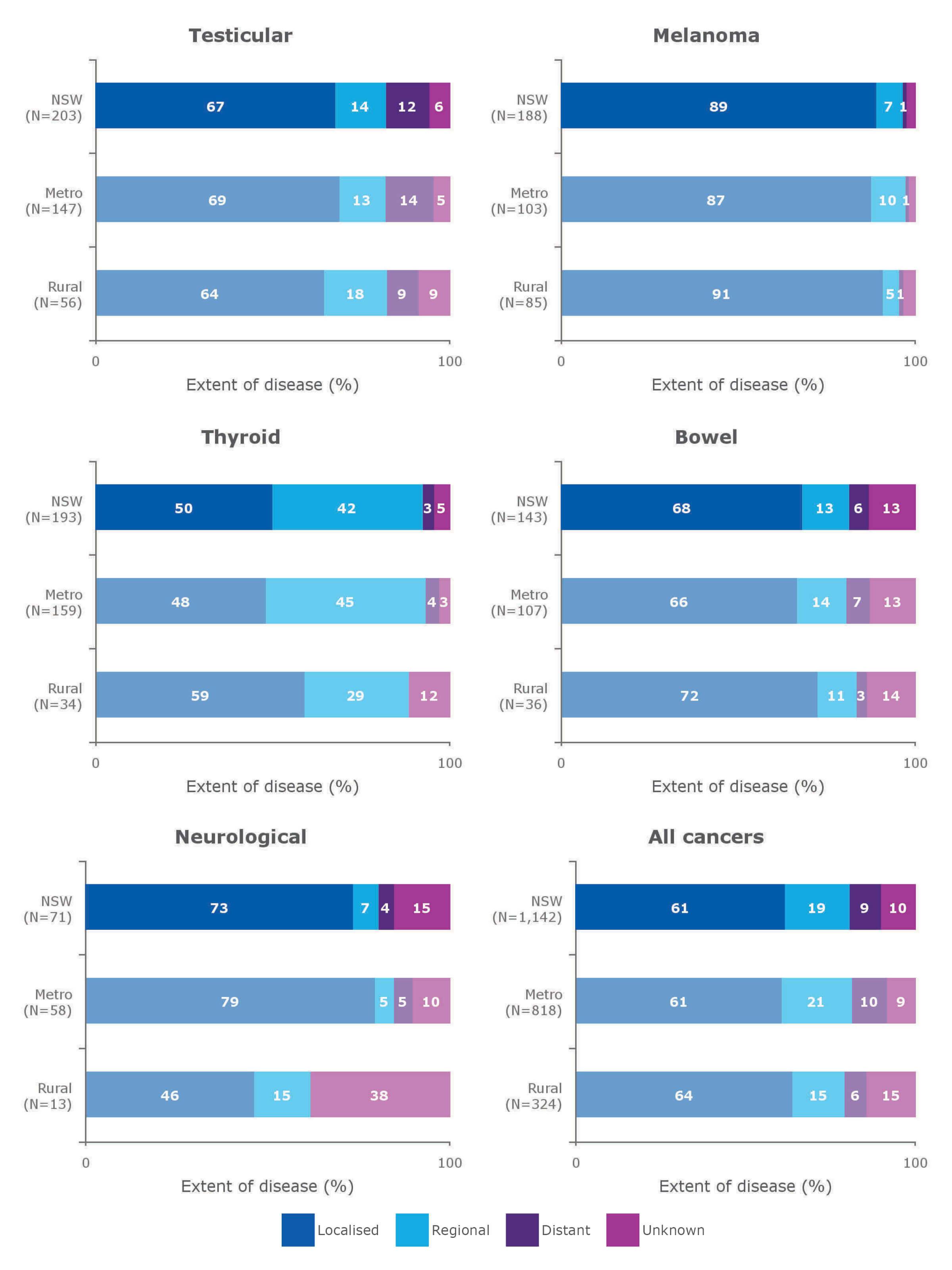
N= Number of cases.
* Excluding haematological cancers, because these are not staged.
Notes:
1. Data source: Annual NSW cancer incidence and mortality data set, 2015 (sourced from the NSW Cancer Registry).
2. Localised: Localised to the tissue of origin.
3. Regional: Spread to adjacent organs and/or regional lymph nodes.
4. Distant: Spread from one part of the body to another.
5. Unknown: Extent of disease at diagnosis is unknown.
Five-year relative survival, by cancer type, for NSW and selected countries, 2005–2009 and 2010–2014
Key finding:
- For lung, ovarian, colon, rectal, gastric, oesophageal and pancreatic cancer in NSW and around the world, five-year relative survival rates increased for people diagnosed in 2010–2014, compared with those diagnosed in 2005–2009.
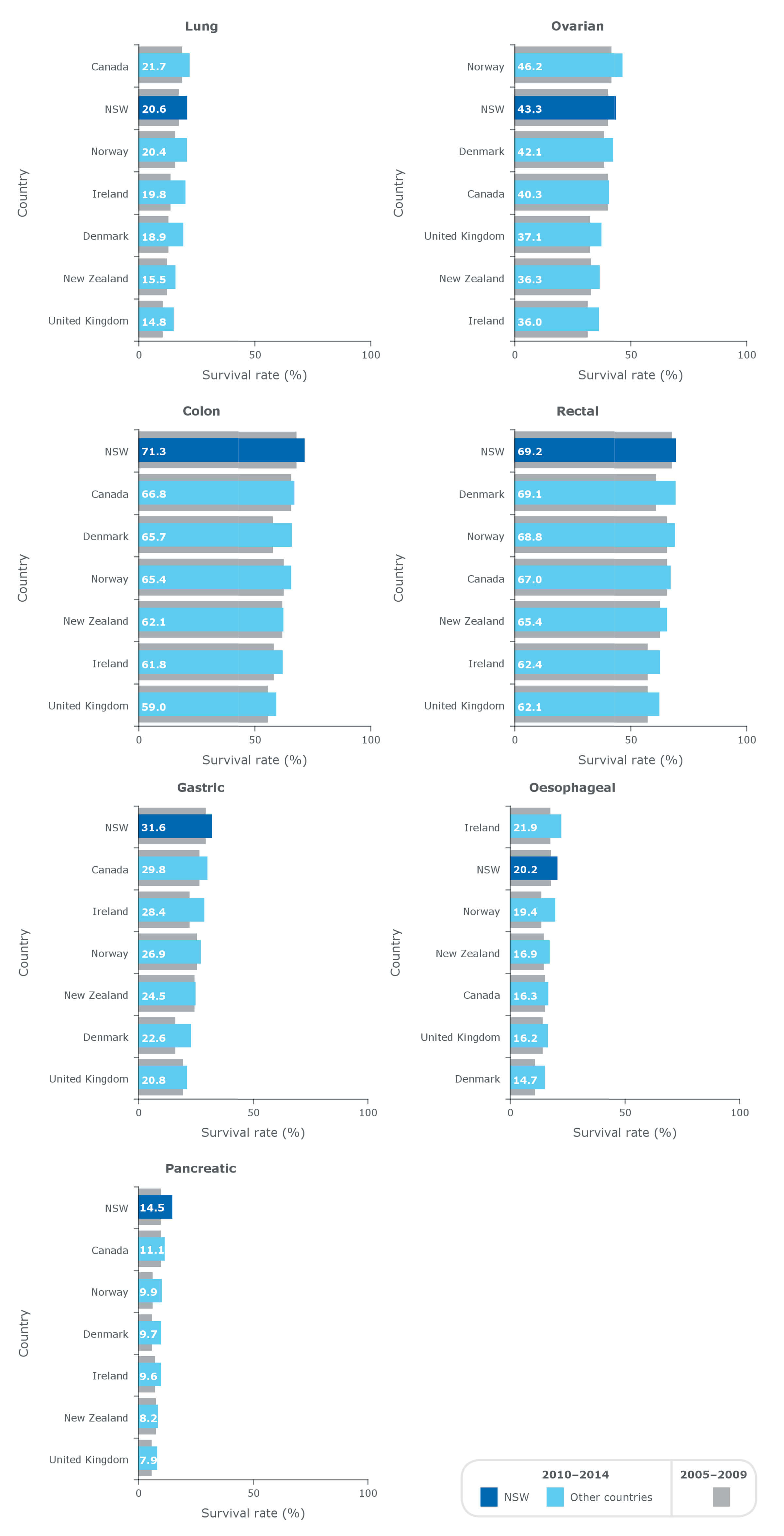
Notes:
1. Data source: International Cancer Benchmarking Partnership (ICBP), phase 2 project Cancer Survival in High-Income Countries (SURVMAR-2).
Why are different time periods and dates reported?
Cancer information is collected from many different sources, so it takes time to review and analyse the data. Different pieces of information may be collected over different time periods, or reported at different times. This means not all the measures reported here have the same dates.
The information presented is the most recent available for each measure at the time this report was written.
Why are confidence intervals reported here?
Confidence intervals are included when a small sample is used to represent the overall population, because there is a chance of an error due to this scaling.
In this report, a 95% confidence interval is presented only on charts where a sample of the population is used. This interval can be thought of as a margin of error.
The larger the sample size, the smaller the confidence interval range. The smaller the sample size, the larger the confidence interval range.
