Do the test
Campaign overview
The Cancer Institute NSW is delivering the 24/25 Bowel Cancer Screening Behaviour Change Campaign to motivate eligible people in NSW to participate in the National Bowel Cancer Screening Program.
The campaign will run from 30 March to 30 June 2025, encompassing Bowel Cancer Awareness Month in June and is being delivered across a range of mass media channels, including radio, regional press, search, and social media (Facebook, Instagram).
Why we need a campaign
Bowel cancer is the second biggest cancer killer in NSW1. It is estimated that approximately 102 people die nationally each week from bowel cancer2, with approximately 35 of these being in NSW.3 Despite this, NSW continues to have one of the lowest National Program participation rates in Australia, at just 38.7%. This remains below all other states and territories, with the exception of the Northern Territory and Queensland.
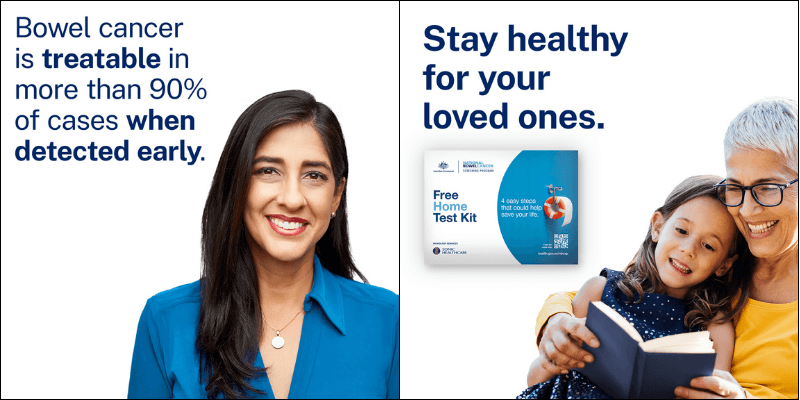
The bowel cancer screening test is highly effective in detecting bowel cancer early, when it can be successfully treated in more than 90% of cases.3 A key strategy in promoting early treatment includes eligible people screening every two years to detect bowel cancer before symptoms appear. Despite this, approximately 60% of eligible people are not doing the National Bowel Cancer Screening Program test when they receive it in the mail.
Target audience
The campaign speaks to the eligible age group, 50–74 year olds in NSW, including a specific focus on Aboriginal people and Arabic, Cantonese, Mandarin, and Vietnamese speakers. Media is skewed towards 50-64 years where screening rates are lowest.
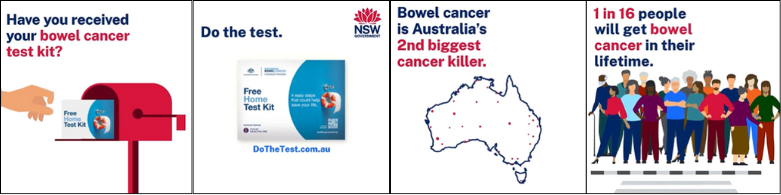
Bowel cancer is Australia’s second biggest cancer killer.4
Key campaign messages
- Bowel cancer is Australia’s second biggest cancer killer.4
- If detected early, bowel cancer can be successfully treated in more than 90% of cases.5
- A bowel cancer screening test will be posted to people aged 50-74 every two years.
- People aged 45-49 can request a test from the National Bowel Cancer Screening Register. (This messaging will be included however, it is important to note that this audience is not included in the key target audiences of the campaign).
Campaign assets
The Campaign uses clear, factual ads to educate people about bowel cancer and screening with the aim of motivating them to do the bowel cancer screening test when it comes in the post.
Please use our assets below to help promote the campaign.

About Cancer Institute NSW
We are NSW’s cancer control agency, established under the Cancer Institute NSW (2003) Act to lessen the impact of cancer across the state. Our vision is to end cancers as we know them. The Institute is the lead agency to implement the NSW Bowel Cancer Screening Program, a comprehensive approach to reduce deaths from bowel cancer by detecting the early signs of the disease.
Further information
- For further information about the campaign and our work to reduce bowel cancer deaths through early detection, visit https://www.cancer.nsw.gov.au/dothetest/
- Or contact us directly at: cinsw-bowelscreening@health.nsw.gov.au
Previous year's campaigns
View previous year's campaigns
Campaign overview
Cancer Institute NSW is delivering the 2021/22 Bowel Cancer Screening Campaign to motivate people aged 50-74 in NSW to participate in the National Bowel Cancer Screening Program.
The campaign is live from 6 February to 28 May 2022 and is being delivered across a range of mass media channels, including TV, radio, press, outdoor advertising, digital display, and social media (Facebook, Instagram).

Why we need a campaign
Bowel cancer is the second biggest cancer killer in NSW1. It is estimated that approximately 102 people die nationally each week from bowel cancer2, with approximately 35 of these being in NSW3. Fortunately, the bowel cancer screening test is highly effective in detecting bowel cancer early, when it can be successfully treated in more than 90% of cases4. A campaign is needed to encourage people aged 50-74 to do the National Bowel Cancer Screening Program test when it arrives in the post, every two years.
There is good evidence that campaigns to promote bowel cancer screening are effective. As a result of the Cancer Institute NSW’s 2020/21 Bowel Cancer Screening Campaign, there was an estimated increase of 17,806 (8.0%) extra National Program test kits returned during the 17-week campaign and subsequent 8-week lag period. By increasing the number of people who do the bowel cancer screening test when they receive it in the post, more bowel cancers can be detected early, providing improved treatment options and saving lives.5
Target audience
The campaign will target people aged 50-74 in NSW, including a specific focus on Aboriginal people and Arabic, Cantonese, Mandarin, Vietnamese, Italian, and Greek speakers. Unfortunately, only 40% of eligible people in NSW are doing the National Bowel Cancer Screening Program test when they receive it in the post. NSW has the second lowest participation rate compared to other states and territories.6
Bowel cancer is Australia’s second biggest cancer killer.7
Key messages
- Bowel cancer is Australia’s second biggest cancer killer.1
- If detected early, bowel cancer can be successfully treated in more than 90% of cases.4
- A bowel cancer screening test will be posted to people aged 50-74 every two years.
- Do the test when it comes in the post.
Campaign assets
The 2021/22 Bowel Cancer Screening Campaign uses clear, factual ads to educate people aged 50-74 about bowel cancer and bowel cancer screening. The ads aim to motivate NSW people aged 50-74 to do the bowel cancer screening test when it comes in the post.
Please use our assets below to help promote the campaign.
Download 2021/22 Bowel Cancer Screening Campaign Toolkit flyer (.pdf)


Further information
- For further information about the campaign and our work to reduce bowel cancer deaths through early detection, visit https://www.cancer.nsw.gov.au/dothetest/
- Or contact us directly at: cinsw-bowelscreening@health.nsw.gov.au
Sources
- Cancer Institute NSW. (2021). Cancer statistics NSW webpage: https://www.cancer.nsw.gov.au/research-and-data/cancer-data-and-statistics/cancer-statistics-nsw#// Accessed: December 2021.
- Australian Institute of Health and Welfare. (2021). National Bowel Cancer Screening Program: Monitoring Report 2021, p.7 & 18. https://www.aihw.gov.au/reports/cancer-screening/nbcsp-monitoring-report-2021/summary. Accessed: December 2021.
- Cancer Institute NSW. (2021). Bowel cancer statistics NSW, Mortality: https://www.cancer.nsw.gov.au/research-and-data/cancer-data-and-statistics/cancer-type-summaries-for-nsw/bowel-cancer-statistics Accessed: December 2021.
- Cancer Australia. (2019). Relative survival by stage at diagnosis (colorectal cancer): https://ncci.canceraustralia.gov.au/outcomes/relative-survival-rate/relative-survival-stage-diagnosis-colorectal-cancer Accessed: December 2021.
- Analysis of bowel cancer outcomes for the National Bowel Cancer Screening Program 2018. Australian Institute of Health and Welfare.
- Australian Institute of Health and Welfare (2021). National Bowel Cancer Screening Program: Monitoring Report 2021, p. 18. https://www.aihw.gov.au/reports/cancer-screening/nbcsp-monitoring-report-2021/summary. Accessed: December 2021.
- Cancer Institute NSW. (2021). Cancer statistics NSW: https://www.cancer.nsw.gov.au/research-and-data/cancer-data-and-statistics/cancer-statistics-nsw#// Accessed: December 2021.
1. NSW Cancer Registry, Cancer Institute NSW. https://www.cancer.nsw.gov.au/research-and-data/cancer-data-and-statistics/data-available-now/cancer-statistics-nsw/cancer-incidence-mortality-survival/detailed-cancer-incidence-mortality Accessed: February 2025
2. Australian Institute of Health and Welfare. (2024). National Bowel Cancer Screening Program: Monitoring Report 2024, p. 50. https://www.aihw.gov.au/reports/cancer-screening/nbcsp-monitoring-2024/summary Accessed: February 2025
3. Cole, S., Tucker, G., Osbourne, J., Byrne, S., Bampton, P., Fraser, R., Young, G. (2013). Shift to earlier stage at diagnosis as a consequence of the National Bowel Cancer Screening Program. Medical Journal of Australia, 198:327-330. Accessed: February 2025
4. NSW Cancer Registry, Cancer Institute NSW. https://www.cancer.nsw.gov.au/research-and-data/cancer-data-and-statistics/data-available-now/cancer-statistics-nsw/cancer-incidence-mortality-survival/detailed-cancer-incidence-mortality Accessed: February 2025
5. Cole, S., Tucker, G., Osbourne, J., Byrne, S., Bampton, P., Fraser, R., Young, G. (2013). Shift to earlier stage at diagnosis as a consequence of the National Bowel Cancer Screening Program. Medical Journal of Australia, 198:327-330. Accessed: February 2025