Brain cancer is the leading cause of cancer-related death in Australian children. The most aggressive types, like diffuse midline glioma (DMG), are incurable.
DMG is an inoperable tumour that arises in the brainstem, mainly affecting children aged six to nine years old. The average survival for children with DMG is less than one year.
Dr Shen witnessed the devastation of DMG firsthand as he underwent neurosurgical training at the Capital Medical University in China. This experience inspired him to pursue a career in brain cancer research, with a focus on DMG.
“Among the cases I encountered in clinic, the most striking and disheartening were children diagnosed with DMG. It was incredibly challenging and emotionally draining to inform their parents that our options were limited to palliative care,” Dr Shen said.
“This personal experience served as a driving force for me to delve into the field of brain cancer research. I firmly believe that fundamental scientific discoveries and medical research are the sole means and beacon of hope to ultimately eradicate brain cancer.”
Dr Shen is now a Senior Medical Scientist and Research Fellow at the Westmead Institute for Medical Research. In 2023, Dr Shen received a Career Development Fellowship worth $671,545 from the Cancer Institute NSW to support his research into finding new ways to treat DMG.
Research to give hope where few options exist
Radiotherapy is currently the only standard treatment for DMG. However, it offers only temporary symptom relief and does not significantly extend survival.
“Our goal is to improve survival outcomes for children diagnosed with DMG by making radiation therapy more effective, without increasing treatment-related toxicity,” Dr Shen said.
The focus of Dr Shen’s work is understanding the reasons for radiation resistance in DMG.
With support from the Career Development Fellowship, Dr Shen and his team are investigating the role of mitochondrial (the energy-making part of our cells) dysfunction in DMG and assessing ways to enhance tumour sensitivity to radiotherapy, using targeted drugs.
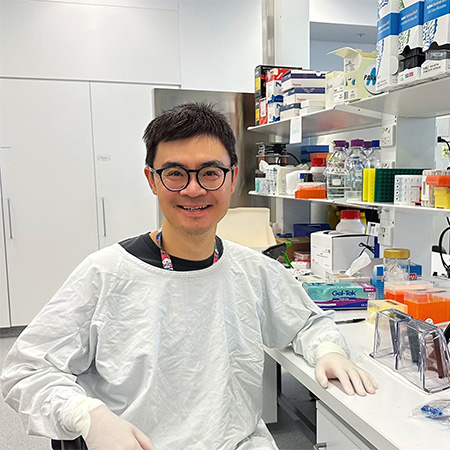
“By targeting these aberrant mitochondrial functions, we aim to develop more effective, less toxic treatment options for children diagnosed with this lethal disease,” Dr Shen said.
Early findings have revealed DMG cells preferentially use oxidative phosphorylation, a chemical process in the mitochondria that produces energy. This type of energy production contributes to the low-oxygen microenvironment that surrounds the tumour, which can reduce the effectiveness of radiotherapy.
“To address this, we have screened a library of drugs and found several promising compounds that can be repurposed to enhance the radiation response in DMG cells. These early findings are paving the way for preclinical studies and future translational applications,” Dr Shen said.
“By identifying novel combination strategies that enhance radiation response, we hope to significantly extend life expectancy and improve the quality of life for patients and their families - offering new hope where few options currently exist.”
Empowering cancer researchers in NSW
The Career Development Fellowship has been integral to building research capacity for Dr Shen’s work, providing salary support and essential funding to advance experimental work.
From a professional aspect, it has aided his transition from an early to mid-career researcher.
“I am working toward establishing myself as an independent group leader in the field. The support from the Cancer Institute NSW is empowering this next phase of my research career.”
Dr Han Shen is a Senior Medical Scientist and Research Fellow at the Westmead Institute for Medical Research. Find out more about his work and some of the next generation of brain cancer researchers supported by the Cancer Institute NSW.