For 2025 International Day of Women and Girls in Science, Dr Feng shared insights about her career journey and research exploring new ways to target bowel cancer.
She also reflected on why diversity is key to driving innovation in the STEM (Science, Technology, Engineering and Mathematics) field and the importance of pursuing your passions with confidence.
People at the heart of call to cancer research
For Dr Yuchen Feng, the pursuit of a career in cancer research was stimulated by her medical training and experiences working on the frontline.
“Witnessing the immense challenges faced by cancer patients, including the limitations of current treatments and the suffering caused by both the disease and its therapies, deeply motivated me to pursue research as a way to make a meaningful difference,” Dr Feng said.
“Research is the key to developing innovative treatments. By focusing on understanding cancer at a deeper level, I aim to contribute to advancements in cancer diagnosis and treatment.”
In 2016, Dr Feng obtained her medical degree before moving from China to NSW to start her PhD at the University of Newcastle and is now an independent researcher focused on cancer biology.

Priming foundations for new targeted therapies
Australia has one of the highest rates of bowel cancer in the world.
In NSW, bowel cancer is the fourth most common cancer with more than 5000 people projected to be diagnosed with the disease in 2025.
Dr Feng was awarded a Cancer Institute NSW Early Career Fellowship worth $597,930 in 2022 for her research that explores the relationship between a type of non-protein molecules (called long non-coding RNA) and bowel cancer.
Most current cancer drug treatments target proteins to block the signals for the cancer to grow. Proteins, however, only make up less than two per cent of the human genome.
Through this project, Dr Feng and her colleagues have found two non-protein molecules that are commonly expressed at higher levels in bowel cancer and are involved in fuelling the disease’s progression.
The team developed innovative drugs designed to silence the function of these non-protein molecules, with results indicating the potential to lead to new treatment approaches for bowel cancer.
“Preclinical studies show that these treatments effectively suppress bowel cancer growth,” Dr Feng said.
“These findings provide a strong foundation for developing new, targeted therapies. In the long run, we aim to translate these findings into clinical practice, offering new treatment options for bowel cancer patients and potentially improving their outcomes.”
In another remarkable discovery, Dr Feng and her team found that these non-protein molecules are also highly expressed in lung cancer tissue.
“This suggests their potential as therapeutic targets not only for bowel cancer but also for lung cancer, broadening the scope of our research and offering hope for more effective treatments across multiple cancer types,” Dr Feng said.
Dr Feng is now in the final year of her Fellowship. She said that beyond supporting the research itself, the Cancer Institute NSW grant has played a pivotal role in her career development.
“The Fellowship has been instrumental in advancing my career by providing the funding and recognition needed to establish myself as an independent researcher,” Dr Feng said.
“It has enabled me to pursue innovative research ideas, build my independent research team and program, attract competitive fundings and foster collaborations with multidisciplinary experts. It has also allowed me to share my findings with both the research community and the public, further enhancing my career trajectory and visibility in the field of cancer research.”
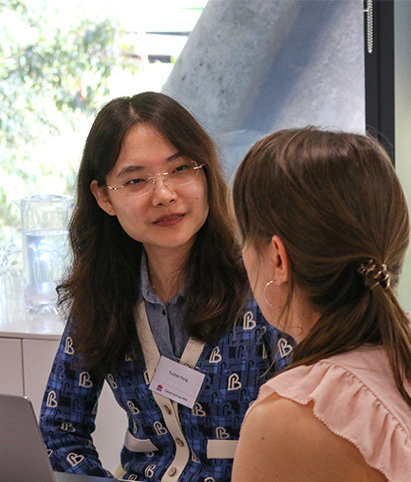
Diversity drives innovation’ in STEM and beyond
International Day of Women and Girls in Science takes place annually on 11 February. Celebrating its tenth year, it promotes equal access to and participation in science for women and girls.
Reflecting on her career journey as a woman in science, Dr Feng said that while she has faced challenges, she has also benefited from the support of inspiring mentors and colleagues.
“I believe diversity drives innovation. I’m committed to fostering an inclusive environment for the next generation of scientists, especially young women,” Dr Feng said.
“While progress toward equity in STEM continues, I’m proud to contribute to this effort and hope to inspire others to pursue science with curiosity and determination.
“My message to women and girls with career ambitions in STEM is to believe in yourself and pursue your passions with confidence. While challenges may arise, remember that resilience, curiosity, and determination will guide you to success.”
The Cancer Institute NSW is proud to support women, like Dr Feng, undertake ground-breaking work in this field and reduce cancer’s impact in NSW.
Since 2004, female researchers have made up more than 56 per cent of investment through the Cancer Institute NSW’s highly prestigious Career Support Program.
“This support creates visibility and an environment where female researchers can thrive, contribute to groundbreaking discoveries, and inspire the next generation of women in science.”
Dr Yuchen Feng is independent researcher at the University of Sydney. Find out more about other recipients of the Cancer Institute NSW’s Career Support Grants.